Using limpa Directly on prolfqua Simulated Data
Witold Wolski
2026-10-21
Source:vignettes/limpa_example.Rmd
limpa_example.RmdThis vignette demonstrates how to use the limpa package directly (without prolfqua wrappers) on peptide-level data simulated with prolfqua. Three analyses are shown:
- Baseline: limma with NAs — standard limma on protein-level medpolish-aggregated data (NAs dropped)
- limpa peptide-level — differential expression at the peptide level (no protein aggregation)
-
limpa protein-level — limpa aggregates peptides to
proteins via
dpcQuant(), then tests for DE
Setup and Data Simulation
Simulate peptide-level data with 3 groups (Ctrl, A, B), 5 replicates per group, and 50 proteins with realistic missing values.
sim <- prolfqua::sim_lfq_data_peptide_config(
  Nprot = 50, N = 5, with_missing = TRUE, seed = 1234
)
lfqdata <- prolfqua::LFQData$new(sim$data, sim$config)
Log2-transform and pivot to a wide matrix (peptides x samples) for limpa.
lfqdata <- lfqdata$get_Transformer()$log2()$lfq
wide <- lfqdata$data_wide(as.matrix = TRUE)

expr_matrix <- wide$data
annotation <- wide$annotation
rowdata <- wide$rowdata

cat("Matrix dimensions:", nrow(expr_matrix), "peptides x", ncol(expr_matrix), "samples\n")
## Matrix dimensions: 152 peptides x 15 samples
cat("Missing values:", sum(is.na(expr_matrix)), "of", length(expr_matrix),
    sprintf("(%.1f%%)\n", 100 * sum(is.na(expr_matrix)) / length(expr_matrix)))
## Missing values: 278 of 2280 (12.2%)## Proteins: 50Design Matrix and Contrasts
All analyses below use the same design matrix: a cell-means model with three groups.
group <- factor(annotation$group_, levels = c("Ctrl", "A", "B"))
design <- stats::model.matrix(~ 0 + group)
colnames(design) <- levels(group)

cont_matrix <- limma::makeContrasts(
  A_vs_Ctrl = A - Ctrl,
  B_vs_Ctrl = B - Ctrl,
  levels = design
)
Baseline: Standard limma Analysis (no limpa)
As a baseline, aggregate peptides to proteins using prolfqua’s
medpolish aggregator, then run a plain limma::lmFit() +
eBayes() analysis. NAs are simply ignored by limma.
lfqdata_protein <- lfqdata$get_Aggregator()$aggregate()
wide_prot <- lfqdata_protein$data_wide(as.matrix = TRUE)
expr_protein_baseline <- wide_prot$data

cat("Protein matrix:", nrow(expr_protein_baseline), "proteins x",
    ncol(expr_protein_baseline), "samples\n")
## Protein matrix: 50 proteins x 15 samples## NAs in protein matrix: 48Fit limma. lmFit handles NAs by fitting each protein on
its available samples only.
fit_baseline <- limma::lmFit(expr_protein_baseline, design)
fit_baseline <- limma::contrasts.fit(fit_baseline, cont_matrix)
fit_baseline <- limma::eBayes(fit_baseline)

results_baseline_A <- limma::topTable(fit_baseline, coef = "A_vs_Ctrl", number = Inf, sort.by = "none")
cat("Baseline limma — A vs Ctrl: ", sum(results_baseline_A$adj.P.Val < 0.05),
    "significant proteins at FDR < 0.05\n")
## Baseline limma — A vs Ctrl: 40 significant proteins at FDR < 0.05
results_baseline_B <- limma::topTable(fit_baseline, coef = "B_vs_Ctrl", number = Inf, sort.by = "none")
cat("Baseline limma — B vs Ctrl: ", sum(results_baseline_B$adj.P.Val < 0.05),
    "significant proteins at FDR < 0.05\n")
## Baseline limma — B vs Ctrl: 36 significant proteins at FDR < 0.05Estimate the Detection Probability Curve (DPC)
The DPC models the probability of observing a peptide as a
logit-linear function of its intensity:
logit P(detected) = beta0 + beta1 * intensity. This is a
global parameter estimated once from the entire peptide-level
dataset.
-
beta1(slope) controls the strength of intensity-dependent missingness: 0 = MCAR, large = MNAR -
beta0(intercept) shifts the detection probability curve left/right
dpc_est <- limpa::dpc(expr_matrix)
cat("DPC parameters: beta0 =", round(dpc_est$dpc[1], 3),
    ", beta1 =", round(dpc_est$dpc[2], 3), "\n")
## DPC parameters: beta0 = -2.424 , beta1 = 1
limpa::plotDPC(dpc_est)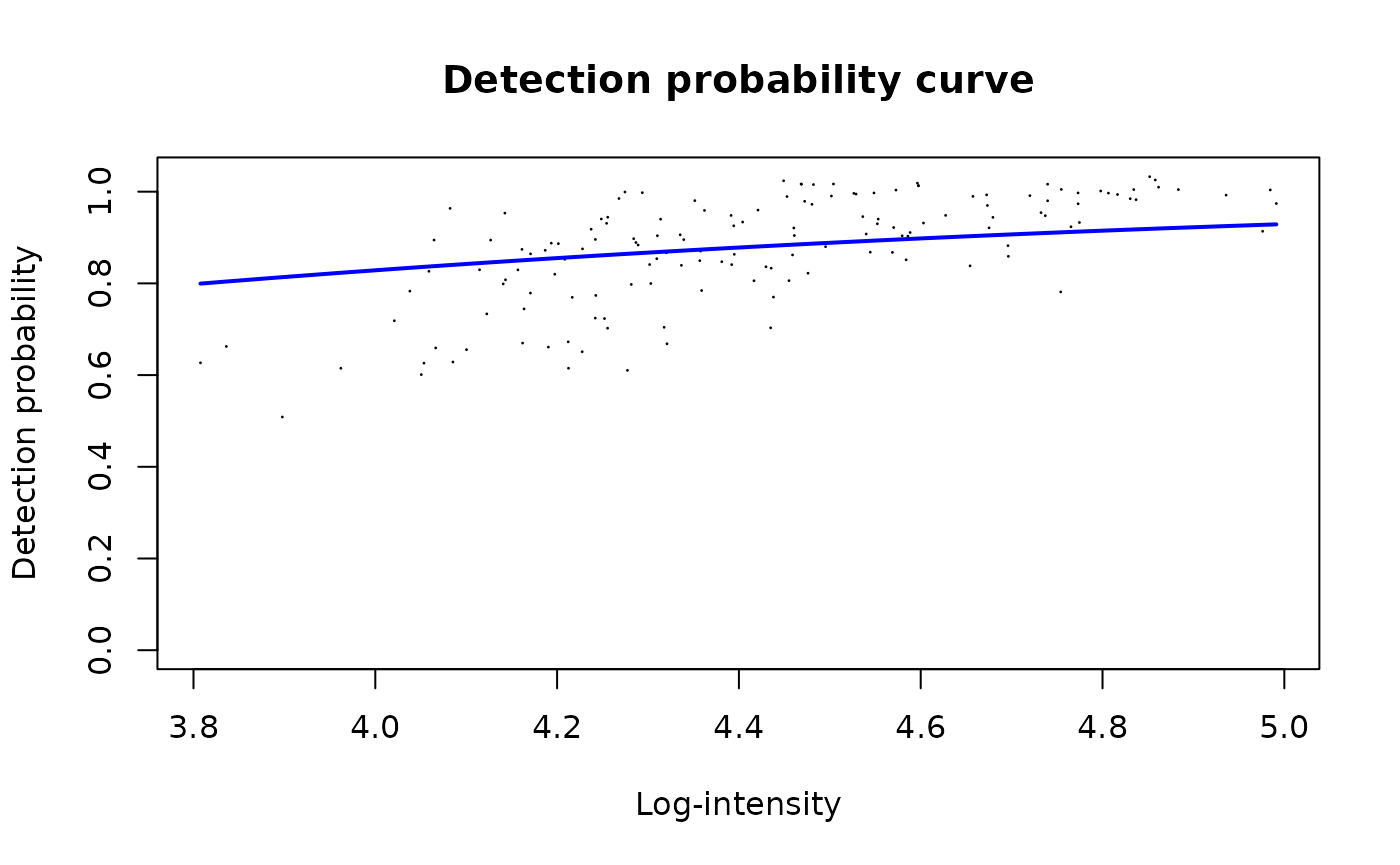
Example 1: Peptide-Level Analysis with limpa
Quantify peptides with dpcQuantByRow()
dpcQuantByRow() quantifies each peptide row
independently (no protein aggregation). Internally it calls
peptides2Proteins() with each row as its own “protein”
(using protein.id = seq_len(nrow(y))). Missing values are
not filled in with fabricated numbers — instead, Bayesian maximum
posterior estimation integrates over the missing values using the
DPC.
y_peptide <- limpa::dpcQuantByRow(expr_matrix, dpc = dpc_est)The result is a limma EList object. Let’s inspect its
structure:
## Class: EList## Slots: E genes other dpc
cat("$E — expression matrix (peptides x samples), no NAs:\n")## $E — expression matrix (peptides x samples), no NAs:## dim: 152 15## NAs: 0## range: 3.28 5.5
cat("$genes — per-peptide annotation:\n")## $genes — per-peptide annotation:
str(y_peptide$genes)## 'data.frame': 152 obs. of 1 variable:
## $ PropObs: num 0.733 0.667 0.8 0.867 0.8 ...
cat("\n")
cat("$other — additional matrices:\n")## $other — additional matrices:## names: n.observations standard.error
cat(" $n.observations — how many precursors were observed per row per sample:\n")## $n.observations — how many precursors were observed per row per sample:## range: 0 1
cat(" $standard.error — posterior SD of the quantification:\n")## $standard.error — posterior SD of the quantification:## range: 0.01 0.3354
cat("$dpc — the DPC parameters used:\n")## $dpc — the DPC parameters used:
print(y_peptide$dpc)## beta0 beta1
## -2.424456 1.000000Key fields:
-
$E: The quantified expression matrix. All NAs from the input have been replaced by maximum posterior estimates (integrating over the DPC). This is a complete matrix. -
$other$standard.error: Per-peptide, per-sample posterior standard deviations. Peptides that were missing get larger SEs. This uncertainty is what limpa propagates into the DE model. -
$other$n.observations: How many observations contributed (1 = observed, 0 = was missing). -
$genes$PropObs: Proportion of samples where the peptide was observed.
Fit the DE model with dpcDE()
dpcDE() is a thin wrapper (9 lines of code) that calls
voomaLmFitWithImputation(). Here is what it passes and
why:
# From limpa/R/dpcDE.R:
dpcDE <- function(y, design, plot=TRUE, ...) {
  eps <- 1e-6
  voomaLmFitWithImputation(
    y         = y,                              # EList with $E and $other
    imputed   = !y$other$n.observations,        # logical matrix: TRUE where value was missing
    design    = design,                         # design matrix
    predictor = log(y$other$standard.error+eps),# log(SE) as precision predictor
    plot      = plot,
    ...
  )
}
Why vooma when SEs are already estimated?
The SEs from dpcQuantByRow()/dpcQuant() are
per-observation quantification uncertainties. But limma needs
observation-level precision weights for the linear model.
voomaLmFitWithImputation() converts the SEs into proper
weights via a bivariate lowess trend:
- Fit an initial
lmFit()to get per-protein residual SDs (sigma) - Model
sqrt(sigma) ~ average_intensity + log(SE)using a bivariate linear predictor - Smooth with lowess to get a mean-variance trend function
f() - Compute weights as
w = 1/f(fitted_value)^4— inverse fourth power of the predicted SD
This is analogous to how voom converts RNA-seq counts
into weights via a mean-variance trend, but extended with a second
predictor (the SE from quantification). The two predictors capture
different variance sources:
- Average intensity: the classical mean-variance relationship in proteomics
- log(SE): additional variance from quantification uncertainty (more missing precursors = larger SE = lower weight)
Additionally, voomaLmFitWithImputation() corrects
residual degrees of freedom for proteins where entire groups were
missing (all values imputed), preventing overconfident inference.
fit_pep <- limpa::dpcDE(y_peptide, design, plot = TRUE)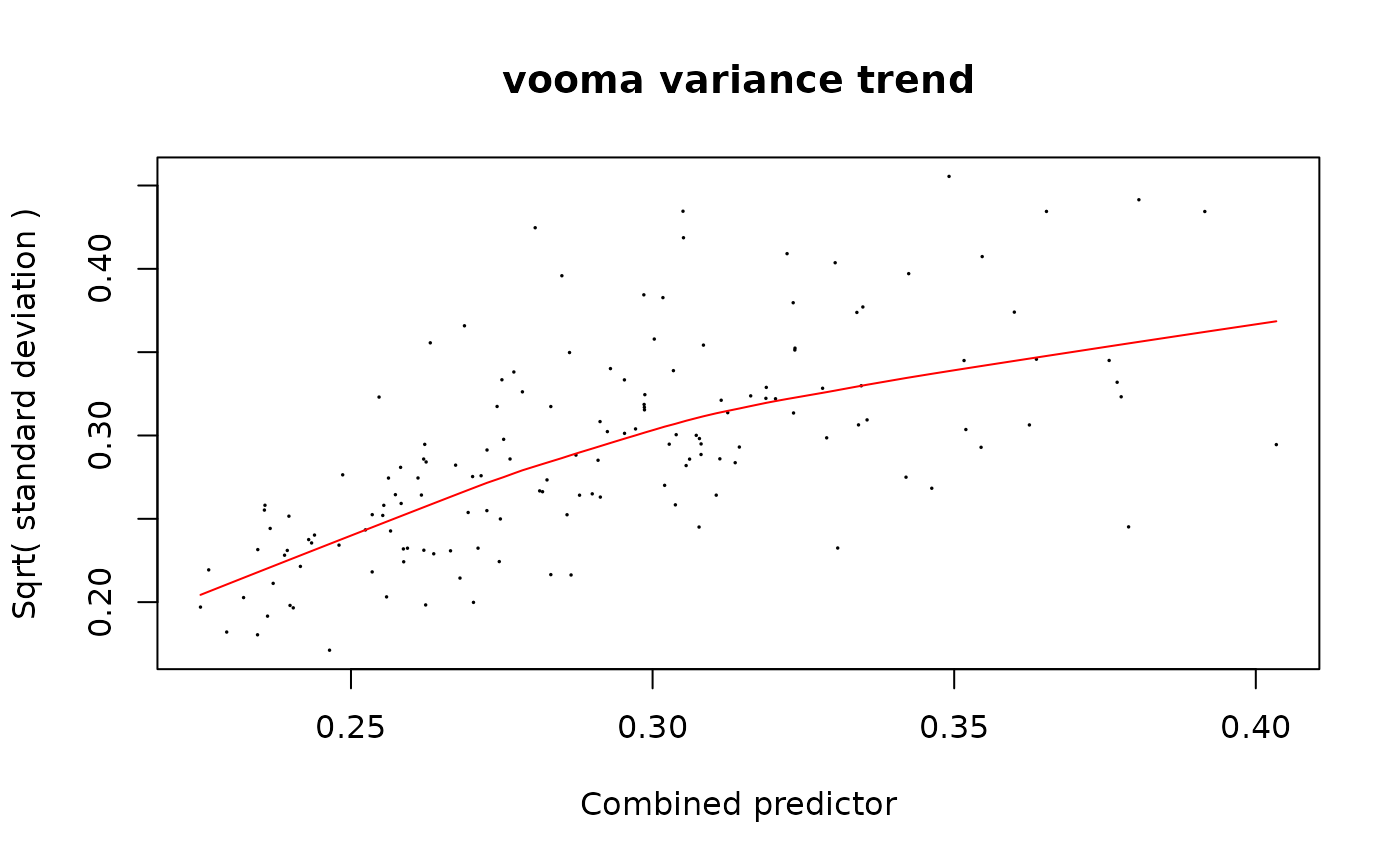
fit_pep <- limma::eBayes(fit_pep)The plot shows sqrt(sigma) vs the combined predictor
(average intensity + log SE). The red line is the lowess trend used to
derive precision weights.
Test contrasts
fit_pep2 <- limma::contrasts.fit(fit_pep, cont_matrix)
fit_pep2 <- limma::eBayes(fit_pep2)
Results for A vs Ctrl at peptide level:
results_pep_A <- limma::topTable(fit_pep2, coef = "A_vs_Ctrl", number = 10, sort.by = "P")
print(results_pep_A)
## PropObs logFC AveExpr t
## 9VUkAq~8655~lfq~MuiCBcCu~lfq~light 1.0000000 -0.8851463 4.898474 -25.27012
## 7QuTub~5556~lfq~YmC8HPCi~lfq~light 0.8666667 0.9350267 4.727822 21.12259
## 9VUkAq~8655~lfq~JBvPc2qc~lfq~light 1.0000000 0.6970139 4.821333 20.11020
## 76k03k~9735~lfq~HZbAVyOK~lfq~light 1.0000000 -0.8821452 4.544532 -18.87531
## 9VUkAq~8655~lfq~SGFBeD1f~lfq~light 1.0000000 0.6462590 4.720641 18.42412
## ydeWJl~7145~lfq~39NMZpix~lfq~light 1.0000000 0.5177794 5.040518 17.54125
## JV3Z7t~7426~lfq~IpbWaJdN~lfq~light 0.9333333 -0.7605254 4.500164 -16.37530
## R2i6w7~5452~lfq~KFwoIdLY~lfq~light 0.8666667 -0.5710462 4.594583 -16.27149
## ZHBkZv~6720~lfq~eKM49i6K~lfq~light 1.0000000 -0.5051761 4.933688 -15.79546
## I1Jk2Z~7286~lfq~TKuvSqs3~lfq~light 0.8666667 -0.6480346 4.548221 -15.31439
## P.Value adj.P.Val B
## 9VUkAq~8655~lfq~MuiCBcCu~lfq~light 2.474814e-24 3.761718e-22 45.50105
## 7QuTub~5556~lfq~YmC8HPCi~lfq~light 9.921773e-22 7.540548e-20 39.52930
## 9VUkAq~8655~lfq~JBvPc2qc~lfq~light 4.999951e-21 2.533308e-19 37.85792
## 76k03k~9735~lfq~HZbAVyOK~lfq~light 3.955087e-20 1.502933e-18 35.85932
## 9VUkAq~8655~lfq~SGFBeD1f~lfq~light 8.659287e-20 2.632423e-18 35.04942
## ydeWJl~7145~lfq~39NMZpix~lfq~light 4.202531e-19 1.064641e-17 33.32434
## JV3Z7t~7426~lfq~IpbWaJdN~lfq~light 3.740607e-18 8.122460e-17 31.31191
## R2i6w7~5452~lfq~KFwoIdLY~lfq~light 4.570919e-18 8.684746e-17 31.04096
## ZHBkZv~6720~lfq~eKM49i6K~lfq~light 1.160866e-17 1.960574e-16 30.03217
## I1Jk2Z~7286~lfq~TKuvSqs3~lfq~light 3.043369e-17 4.625921e-16 29.12106Results for B vs Ctrl at peptide level:
results_pep_B <- limma::topTable(fit_pep2, coef = "B_vs_Ctrl", number = 10, sort.by = "P")
print(results_pep_B)
## PropObs logFC AveExpr t
## 9VUkAq~8655~lfq~40DK097A~lfq~light 0.9333333 1.0947462 4.809034 25.61456
## 9VUkAq~8655~lfq~MuiCBcCu~lfq~light 1.0000000 -0.6794121 4.898474 -21.57928
## MlNn1V~1396~lfq~PioauYsp~lfq~light 1.0000000 -0.6125184 4.818538 -18.95112
## I1Jk2Z~7286~lfq~TKuvSqs3~lfq~light 0.8666667 -0.8846547 4.548221 -17.11230
## 9VUkAq~8655~lfq~SGFBeD1f~lfq~light 1.0000000 0.5633911 4.720641 15.73300
## 7QuTub~5556~lfq~O5eT1xAS~lfq~light 1.0000000 0.6513203 4.574564 15.39969
## Fl4JiV~6934~lfq~tjP5Q817~lfq~light 0.8666667 0.5837830 4.719694 15.16521
## 7soopj~3451~lfq~WkbauTR1~lfq~light 1.0000000 0.4407287 4.899098 15.16147
## JcKVfU~1514~lfq~mCsMGaAU~lfq~light 1.0000000 0.6780110 4.330367 14.77820
## SGIVBl~4918~lfq~U6LlOS6x~lfq~light 0.8000000 0.8278659 4.200734 14.57807
## P.Value adj.P.Val B
## 9VUkAq~8655~lfq~40DK097A~lfq~light 1.566024e-24 2.380356e-22 45.95730
## 9VUkAq~8655~lfq~MuiCBcCu~lfq~light 4.887857e-22 3.714771e-20 40.10657
## MlNn1V~1396~lfq~PioauYsp~lfq~light 3.472411e-20 1.759355e-18 35.84954
## I1Jk2Z~7286~lfq~TKuvSqs3~lfq~light 9.265354e-19 3.520834e-17 32.67289
## 9VUkAq~8655~lfq~SGFBeD1f~lfq~light 1.313960e-17 3.994439e-16 29.93253
## 7QuTub~5556~lfq~O5eT1xAS~lfq~light 2.561092e-17 6.488100e-16 29.18613
## Fl4JiV~6934~lfq~tjP5Q817~lfq~light 4.122372e-17 7.892554e-16 28.73952
## 7soopj~3451~lfq~WkbauTR1~lfq~light 4.153976e-17 7.892554e-16 28.59601
## JcKVfU~1514~lfq~mCsMGaAU~lfq~light 9.152959e-17 1.545833e-15 28.01480
## SGIVBl~4918~lfq~U6LlOS6x~lfq~light 1.390940e-16 2.114228e-15 27.68235Summary of significant peptides (FDR < 0.05):
res_all_pep <- limma::topTable(fit_pep2, coef = "A_vs_Ctrl", number = Inf, sort.by = "none")
cat("A vs Ctrl: ", sum(res_all_pep$adj.P.Val < 0.05), "significant peptides at FDR < 0.05\n")
## A vs Ctrl: 122 significant peptides at FDR < 0.05
res_all_pep_B <- limma::topTable(fit_pep2, coef = "B_vs_Ctrl", number = Inf, sort.by = "none")
cat("B vs Ctrl: ", sum(res_all_pep_B$adj.P.Val < 0.05), "significant peptides at FDR < 0.05\n")
## B vs Ctrl: 115 significant peptides at FDR < 0.05Low-Level API: Step-by-Step Peptide Analysis
This section decomposes the limpa pipeline into individual function
calls, showing exactly what happens at each stage. We reuse the same
expr_matrix, dpc_est, and design
from above.
Step 1: Estimate the DPC
Already done above, but for completeness:
dpc_est <- limpa::dpc(expr_matrix)
cat("DPC: beta0 =", round(dpc_est$dpc["beta0"], 3),
    ", beta1 =", round(dpc_est$dpc["beta1"], 3), "\n")
## DPC: beta0 = -2.424 , beta1 = 1The dpc() return value also contains hyperparameters
estimated from the data:
format_dpc_hyperparameter <- function(dpc_result, field) {
  value <- dpc_result[[field]]
  if (is.numeric(value) && length(value) == 1 && !is.na(value)) {
    return(round(value, 3))
  }
  "not available"
}

cat("mu.prior  (prior mean of row means):", format_dpc_hyperparameter(dpc_est, "mu.prior"), "\n")
## mu.prior (prior mean of row means): 4.448
cat("df.prior (prior df for variance):", format_dpc_hyperparameter(dpc_est, "df.prior"), "\n")## df.prior (prior df for variance): 3.48
cat("s2.prior (prior variance):", format_dpc_hyperparameter(dpc_est, "s2.prior"), "\n")## s2.prior (prior variance): 0.032Step 2: Quantify peptides (row-level, no aggregation)
dpcQuantByRow() calls peptides2Proteins()
internally, treating each row as its own “protein” (i.e.,
protein.id = 1:nrow(y)). The result is an
EList:
y_pep <- limpa::dpcQuantByRow(expr_matrix, dpc = dpc_est)Step 3: Prepare inputs for the variance model
dpcDE() is just 3 lines. Here we do what it does
manually:
# Logical matrix: TRUE where the original value was missing
imputed_matrix <- !y_pep$other$n.observations

cat("Imputed values:", sum(imputed_matrix), "of", length(imputed_matrix), "\n")
## Imputed values: 278 of 2280
# Log(SE) as a precision predictor for the variance trend
eps <- 1e-6
predictor <- log(y_pep$other$standard.error + eps)

cat("Predictor (log SE) range:", round(range(predictor), 2), "\n")
## Predictor (log SE) range: -4.61 -1.09Step 4: What voomaLmFitWithImputation() does
internally
Below we manually replicate the internals of
voomaLmFitWithImputation(). This is the core of limpa’s DE
pipeline.
Step 4a: Initial linear model fit (unweighted)
First, fit a standard lmFit() without any precision
weights. This gives per-peptide residual standard deviations
(sigma) and fitted values.
## Initial fit — unweighted:## Coefficients: 152 3 (peptides x groups)## Sigma range: 0.0293 0.2075## df.residual: 12
# Compute per-observation fitted values (peptides x samples)
fitted_values <- fit0$coefficients %*% t(fit0$design)
cat("  Fitted values:", dim(fitted_values), "\n")
## Fitted values: 152 15Step 4b: DF correction for fully imputed groups
If a peptide has ALL values imputed within a design-matrix group, its fitted value for that group is determined entirely by imputed data — so the residual df should be reduced. This uses the hat matrix to detect such cases.
h <- 1 - hat(design)  # leverage complement per sample
df_imputed <- imputed_matrix %*% (1 - h)  # effective imputed df per peptide

n_affected <- sum(df_imputed > 0.9999)
cat("Peptides with fully-imputed groups:", n_affected, "\n")
## Peptides with fully-imputed groups: 16
# For affected peptides, refit on observed-only data to get corrected sigma/df
if (n_affected > 0) {
  affected_idx <- which(rowSums(df_imputed > 0.9999) > 0)
  E_affected <- y_pep$E[affected_idx, , drop = FALSE]
  E_affected_NA <- E_affected
  E_affected_NA[imputed_matrix[affected_idx, , drop = FALSE]] <- NA
  fit_NA <- suppressWarnings(limma::lmFit(E_affected_NA, design))

  cat("Corrected df.residual for affected peptides:", fit_NA$df.residual[1:min(5, length(fit_NA$df.residual))], "\n")

  # Replace sigma and df for affected rows
  fit0$sigma[affected_idx] <- fit_NA$sigma
  fit0$df.residual[affected_idx] <- fit_NA$df.residual
}
## Corrected df.residual for affected peptides: 7 7 6 7 6Step 4c: Bivariate linear predictor (average intensity + log SE)
This is the key innovation over standard vooma. Instead
of modelling variance as a function of average intensity alone, limpa
uses TWO predictors:
-
sx= average log2 expression per peptide (classical mean-variance axis) -
sxc= average log(SE) per peptide (quantification uncertainty axis)
A linear model sqrt(sigma) ~ sx + sxc combines them into
a single predictor.
# Average expression per peptide
sx <- rowMeans(y_pep$E, na.rm = TRUE)

# Residual SD (square root for the variance trend)
sy <- sqrt(fit0$sigma)

# Average log(SE) per peptide — the precision predictor
sxc <- rowMeans(predictor, na.rm = TRUE)

# Bivariate linear model: sqrt(sigma) ~ 1 + avg_intensity + avg_log_SE
vartrend <- lm.fit(cbind(1, sx, sxc), sy)
beta <- coef(vartrend)
cat("Variance trend coefficients:\n")
## Variance trend coefficients:## Intercept: 0.6832## avg_intensity: -0.0789
cat("  avg_log_SE:", round(beta[3], 4),
    ifelse(beta[3] > 0, " (higher SE → higher variance, as expected)", ""), "\n")
## avg_log_SE: 0.0119 (higher SE → higher variance, as expected)
# Combined predictor (per-peptide summary for the lowess x-axis)
sx_combined <- vartrend$fitted.values

# Per-observation combined predictor (for computing weights later)
mu_combined <- beta[1] + beta[2] * fitted_values + beta[3] * predictor
Step 4d: Lowess smoothing of the variance trend
Smooth the sqrt(sigma) ~ combined_predictor relationship
with lowess. The smoothed trend function f() will be used
to derive weights.
span <- limma::chooseLowessSpan(nrow(y_pep), small.n = 50, min.span = 0.3, power = 1/3)
cat("Lowess span:", round(span, 3), "\n")
## Lowess span: 0.783
l <- lowess(sx_combined, sy, f = span)

# Plot the trend
plot(sx_combined, sy,
     xlab = "Combined predictor (avg intensity + log SE)",
     ylab = "Sqrt(sigma)",
     pch = 16, cex = 0.5, col = "grey40",
     main = "vooma variance trend (manual)")
lines(l, col = "red", lwd = 2)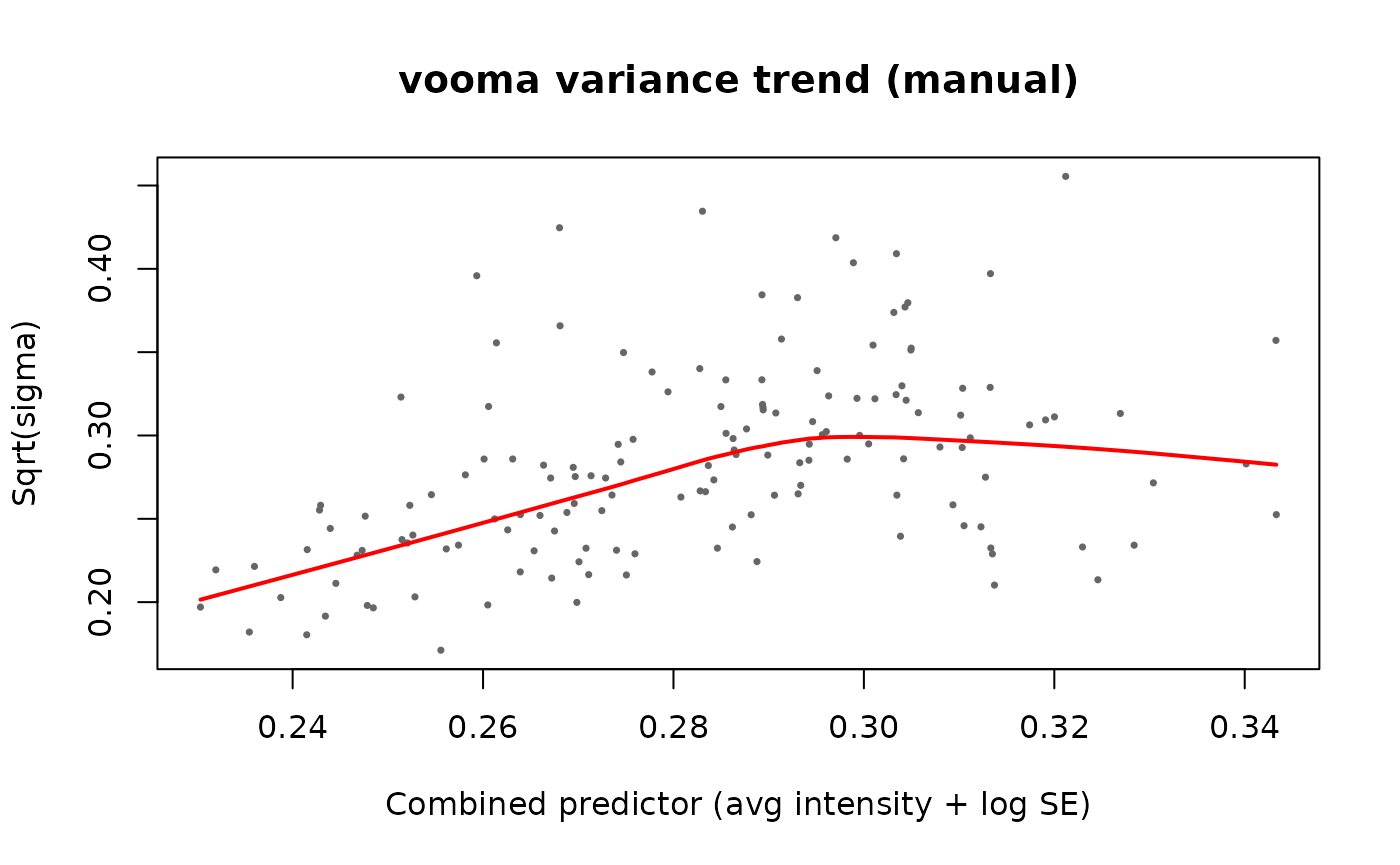
Step 4e: Derive precision weights
The lowess trend gives a function f() that predicts
sqrt(sigma) from the combined predictor. Weights are the
inverse fourth power: w = 1/f(mu)^4. This means
observations with higher predicted variance get lower weight.
# Interpolating function from the lowess fit
f_trend <- approxfun(l, rule = 2, ties = list("ordered", mean))

# Per-observation weights: 1/f(mu_ij)^4
w_manual <- 1 / f_trend(mu_combined)^4
dim(w_manual) <- dim(y_pep$E)

cat("Weights matrix:", dim(w_manual), "\n")
## Weights matrix: 152 15## Weight range: 124.89 606.68## Weight median: 165.13
# Show how weights relate to missingness
cat("\nMean weight for observed values:", round(mean(w_manual[!imputed_matrix]), 2), "\n")
##
## Mean weight for observed values: 237.64## Mean weight for imputed values: 150.99Imputed values get systematically lower weights because they have larger SEs, which pushes them to the high-variance end of the trend.
Step 4f: Final weighted linear model fit
Refit lmFit() using the vooma weights. This is the final
model — coefficients now reflect precision-weighted estimates.
fit_vooma <- limma::lmFit(y_pep, design, weights = w_manual)

# Re-apply DF correction for affected peptides
if (n_affected > 0) {
  fit_NA_w <- suppressWarnings(limma::lmFit(E_affected_NA, design,
                                            weights = w_manual[affected_idx, , drop = FALSE]))
  fit_vooma$sigma[affected_idx] <- fit_NA_w$sigma
  fit_vooma$df.residual[affected_idx] <- fit_NA_w$df.residual
}

cat("Final weighted fit:\n")
## Final weighted fit:## Sigma range: 0.439 2.5172## df.residual range: 5 12At this point fit_vooma is an MArrayLM with
precision-weighted coefficient estimates but no empirical Bayes
moderation yet.
Step 5: Empirical Bayes moderation with eBayes()
eBayes() shrinks the per-peptide variance estimates
toward a common prior, producing moderated t-statistics with increased
degrees of freedom:
fit_eb <- limma::eBayes(fit_vooma)

cat("Before eBayes — df.residual[1:5]:", fit_vooma$df.residual[1:5], "\n")
## Before eBayes — df.residual[1:5]: 12 7 12 12 12
cat("After eBayes — df.total[1:5]: ", fit_eb$df.total[1:5], "\n")## After eBayes — df.total[1:5]: 21.92524 16.92524 21.92524 21.92524 21.92524## Prior df (df.prior): 9.93## Prior variance (s2.prior): 1.1021Step 6: Compute contrasts with contrasts.fit()
contrasts.fit() re-parameterizes the fitted model from
design-matrix coefficients to the contrasts of interest:
fit_contr <- limma::contrasts.fit(fit_eb, cont_matrix)
cat("Contrast coefficients:", colnames(fit_contr$coefficients), "\n")
## Contrast coefficients: A_vs_Ctrl B_vs_Ctrl## Dimensions: 152 2Apply eBayes() again after re-parameterization (this
re-computes moderated statistics for the contrast coefficients):
fit_contr <- limma::eBayes(fit_contr)Step 7: Extract results with topTable()
##                                      PropObs      logFC  AveExpr         t
## 9VUkAq~8655~lfq~MuiCBcCu~lfq~light 1.0000000 -0.8851463 4.898474 -24.93390
## 9VUkAq~8655~lfq~JBvPc2qc~lfq~light 1.0000000  0.6970139 4.821333  20.12626
## 9VUkAq~8655~lfq~SGFBeD1f~lfq~light 1.0000000  0.6462590 4.720641  19.40684
## 76k03k~9735~lfq~HZbAVyOK~lfq~light 1.0000000 -0.8821452 4.544532 -18.90755
## ydeWJl~7145~lfq~39NMZpix~lfq~light 1.0000000  0.5177794 5.040518  18.22853
## 7QuTub~5556~lfq~YmC8HPCi~lfq~light 0.8666667  0.8763615 4.727822  17.92095
## ZHBkZv~6720~lfq~eKM49i6K~lfq~light 1.0000000 -0.5051761 4.933688 -16.46951
## R2i6w7~5452~lfq~KFwoIdLY~lfq~light 0.8666667 -0.5710462 4.594583 -16.12305
## R2i6w7~5452~lfq~2vAYUEfz~lfq~light 1.0000000  0.4678078 4.810543  15.99482
## ZHBkZv~6720~lfq~nLeEGNEy~lfq~light 1.0000000 -0.4166154 4.975519 -14.76092
##                                         P.Value    adj.P.Val        B
## 9VUkAq~8655~lfq~MuiCBcCu~lfq~light 1.392189e-17 2.116127e-15 30.41508
## 9VUkAq~8655~lfq~JBvPc2qc~lfq~light 1.261731e-15 9.589152e-14 25.86910
## 9VUkAq~8655~lfq~SGFBeD1f~lfq~light 2.690943e-15 1.363411e-13 25.16606
## 76k03k~9735~lfq~HZbAVyOK~lfq~light 4.620372e-15 1.755741e-13 24.63018
## ydeWJl~7145~lfq~39NMZpix~lfq~light 9.839263e-15 2.991136e-13 23.70404
## 7QuTub~5556~lfq~YmC8HPCi~lfq~light 1.397128e-14 3.539391e-13 23.49254
## ZHBkZv~6720~lfq~eKM49i6K~lfq~light 7.872433e-14 1.709443e-12 21.66616
## R2i6w7~5452~lfq~KFwoIdLY~lfq~light 1.212708e-13 2.304146e-12 21.30782
## R2i6w7~5452~lfq~2vAYUEfz~lfq~light 1.425879e-13 2.408151e-12 21.03298
## ZHBkZv~6720~lfq~nLeEGNEy~lfq~light 7.181412e-13 1.091575e-11 19.32675
topTable() returns:
-
logFC— the contrast estimate (log2 fold change) -
AveExpr— average expression across all samples -
t— moderated t-statistic -
P.Value— p-value from the moderated t-test -
adj.P.Val— BH-adjusted p-value (FDR) -
B— log-odds of differential expression
Step 8: Verify equivalence with dpcDE() wrapper
The low-level pipeline should give identical results to
dpcDE():
# Compare with the high-level result from Example 1
tt_highlevel <- limma::topTable(fit_pep2, coef = "A_vs_Ctrl", number = Inf, sort.by = "none")
tt_lowlevel <- limma::topTable(fit_contr, coef = "A_vs_Ctrl", number = Inf, sort.by = "none")

# Match by rownames and compare logFC
common <- intersect(rownames(tt_highlevel), rownames(tt_lowlevel))
max_diff <- max(abs(tt_highlevel[common, "logFC"] - tt_lowlevel[common, "logFC"]))
cat("Max logFC difference between high-level and low-level:", max_diff, "\n")
## Max logFC difference between high-level and low-level: 0.1740179Example 2: Protein-Level Analysis with limpa
Quantify proteins with dpcQuant()
dpcQuant() aggregates peptides to proteins using
Bayesian maximum posterior estimation. For each protein it fits an
additive model: y_ij = mu_j + alpha_i + epsilon_ij where
mu_j is the protein expression in sample j and
alpha_i is the peptide-specific offset. Missing values are
integrated out via the DPC (Gauss quadrature, 16 nodes).
protein_id <- rowdata$protein_Id
y_protein <- limpa::dpcQuant(expr_matrix, protein.id = protein_id, dpc = dpc_est)
Inspect the EList structure — same slots as peptide-level but now at protein level:
## Class: EList## Slots: E genes other dpc prior.mean prior.sd prior.logFC
cat("$E — protein expression matrix (no NAs):\n")## $E — protein expression matrix (no NAs):## dim: 50 15## NAs: 0## range: 2.59 5.22
cat("$genes — per-protein annotation:\n")## $genes — per-protein annotation:
str(y_protein$genes)## 'data.frame': 50 obs. of 3 variables:
## $ Protein : chr "0EfVhX~7161" "0m5WN4~3543" "76k03k~9735" "7cbcrd~0495" ...
## $ NPeptides: num 4 1 3 2 12 2 7 1 1 1 ...
## $ PropObs : num 0.767 0.8 0.911 0.833 0.911 ...
cat(" NPrec: number of precursor peptides per protein\n")## NPrec: number of precursor peptides per protein
cat(" PropObs: proportion of (peptide x sample) values that were observed\n\n")## PropObs: proportion of (peptide x sample) values that were observed
cat("$other$standard.error — posterior SD of protein quantification:\n")## $other$standard.error — posterior SD of protein quantification:## dim: 50 15## range: 0.0544 0.9587
cat(" Proteins with more missing peptides get larger SEs.\n\n")## Proteins with more missing peptides get larger SEs.
cat("$other$n.observations — observed peptide count per protein x sample:\n")## $other$n.observations — observed peptide count per protein x sample:## range: 0 13
cat("$dpc, $prior.mean, $prior.sd, $prior.logFC — hyperparameters:\n")## $dpc, $prior.mean, $prior.sd, $prior.logFC — hyperparameters:## DPC: -2.424 1## prior.mean: 4.446## prior.sd: 1## prior.logFC: 1Key difference from dpcQuantByRow():
Here multiple peptide rows are aggregated into one protein row. The
$other$standard.error now reflects both the within-protein
variance and the impact of missing peptides. $genes$NPrec
records how many peptides each protein had.
Fit the DE model
Same dpcDE() call — it passes log(SE) as a
precision predictor and the !n.observations matrix as the
imputation indicator to voomaLmFitWithImputation().
fit_prot <- limpa::dpcDE(y_protein, design, plot = TRUE)
fit_prot <- limma::eBayes(fit_prot)Test contrasts
fit_prot2 <- limma::contrasts.fit(fit_prot, cont_matrix)
fit_prot2 <- limma::eBayes(fit_prot2)
Results for A vs Ctrl at protein level:
results_prot_A <- limma::topTable(fit_prot2, coef = "A_vs_Ctrl", number = 10, sort.by = "P")
print(results_prot_A)
## Protein NPeptides PropObs logFC AveExpr t
## ZHBkZv~6720 ZHBkZv~6720 4 0.9833333 -0.2583529 4.950277 -14.812933
## WjJPCz~7827 WjJPCz~7827 1 1.0000000 -0.4403868 4.631240 -12.939796
## MlNn1V~1396 MlNn1V~1396 2 1.0000000 -0.2718993 4.821361 -12.855006
## HvIpHG~7584 HvIpHG~7584 5 0.9466667 0.2745891 4.514262 12.025055
## bzNYQZ~8203 bzNYQZ~8203 1 0.9333333 0.5416581 4.744370 11.055890
## 76k03k~9735 76k03k~9735 3 0.9111111 -0.4931572 4.421848 -10.758415
## HC8K98~2990 HC8K98~2990 5 0.8800000 0.3341430 4.294403 10.067570
## CGzoYe~1248 CGzoYe~1248 4 0.8500000 -0.4011100 4.332492 -9.800020
## RE5qEz~1673 RE5qEz~1673 1 0.9333333 -0.4840450 4.715879 -9.497023
## JV3Z7t~7426 JV3Z7t~7426 3 0.9555556 -0.3182202 4.405652 -9.425948
## P.Value adj.P.Val B
## ZHBkZv~6720 3.787242e-11 1.893621e-09 15.778462
## WjJPCz~7827 3.155472e-10 5.823415e-09 10.683775
## MlNn1V~1396 3.494049e-10 5.823415e-09 12.884031
## HvIpHG~7584 9.765832e-10 1.220729e-08 12.517505
## bzNYQZ~8203 3.493699e-09 3.493699e-08 7.619774
## 76k03k~9735 5.257219e-09 4.381016e-08 7.708187
## HC8K98~2990 1.404891e-08 1.003494e-07 9.583842
## CGzoYe~1248 2.083358e-08 1.302099e-07 7.423545
## RE5qEz~1673 3.285842e-08 1.825468e-07 6.098896
## JV3Z7t~7426 3.661917e-08 1.830958e-07 8.117392Results for B vs Ctrl at protein level:
results_prot_B <- limma::topTable(fit_prot2, coef = "B_vs_Ctrl", number = 10, sort.by = "P")
print(results_prot_B)
## Protein NPeptides PropObs logFC AveExpr t
## bkh7dJ~8025 bkh7dJ~8025 8 0.8666667 0.2987665 4.294359 14.579482
## WjJPCz~7827 WjJPCz~7827 1 1.0000000 -0.5157402 4.631240 -13.799320
## 9VUkAq~8655 9VUkAq~8655 7 0.9809524 0.2236035 4.760002 13.643693
## GK8UnK~3043 GK8UnK~3043 3 0.8888889 0.4677256 4.510816 13.171665
## SGIVBl~4918 SGIVBl~4918 3 0.6666667 0.9271119 4.006036 12.388901
## ZDkJUz~5298 ZDkJUz~5298 2 0.9666667 0.4227250 4.777733 12.175212
## MlNn1V~1396 MlNn1V~1396 2 1.0000000 -0.2254504 4.821361 -11.338766
## aWq1bG~4505 aWq1bG~4505 1 1.0000000 0.3873877 4.879590 10.173555
## JV3Z7t~7426 JV3Z7t~7426 3 0.9555556 -0.3589473 4.405652 -9.932478
## r2J0Eh~3817 r2J0Eh~3817 1 0.9333333 0.5107426 4.557161 9.792101
## P.Value adj.P.Val B
## bkh7dJ~8025 4.869415e-11 2.303880e-09 15.529315
## WjJPCz~7827 1.157333e-10 2.303880e-09 14.746906
## 9VUkAq~8655 1.382328e-10 2.303880e-09 14.286545
## GK8UnK~3043 2.394583e-10 2.993228e-09 13.924344
## SGIVBl~4918 6.180609e-10 6.180609e-09 11.795755
## ZDkJUz~5298 8.074886e-10 6.729072e-09 12.826201
## MlNn1V~1396 2.387271e-09 1.705193e-08 11.463486
## aWq1bG~4505 1.204399e-08 7.527495e-08 9.900414
## JV3Z7t~7426 1.712493e-08 9.513849e-08 9.767011
## r2J0Eh~3817 2.108046e-08 1.054023e-07 9.631231Summary of significant proteins (FDR < 0.05):
res_all_prot <- limma::topTable(fit_prot2, coef = "A_vs_Ctrl", number = Inf, sort.by = "none")
cat("limpa protein — A vs Ctrl: ", sum(res_all_prot$adj.P.Val < 0.05),
    "significant proteins at FDR < 0.05\n")
## limpa protein — A vs Ctrl: 41 significant proteins at FDR < 0.05
res_all_prot_B <- limma::topTable(fit_prot2, coef = "B_vs_Ctrl", number = Inf, sort.by = "none")
cat("limpa protein — B vs Ctrl: ", sum(res_all_prot_B$adj.P.Val < 0.05),
    "significant proteins at FDR < 0.05\n")
## limpa protein — B vs Ctrl: 39 significant proteins at FDR < 0.05Summary Comparison
comparison <- data.frame(
  method = c("baseline limma (medpolish + lmFit)",
             "limpa peptide-level (dpcQuantByRow + dpcDE)",
             "limpa protein-level (dpcQuant + dpcDE)"),
  sig_A_vs_Ctrl = c(
    sum(results_baseline_A$adj.P.Val < 0.05),
    sum(res_all_pep$adj.P.Val < 0.05),
    sum(res_all_prot$adj.P.Val < 0.05)
  ),
  sig_B_vs_Ctrl = c(
    sum(results_baseline_B$adj.P.Val < 0.05),
    sum(res_all_pep_B$adj.P.Val < 0.05),
    sum(res_all_prot_B$adj.P.Val < 0.05)
  )
)
knitr::kable(comparison, col.names = c("Method", "Sig. A vs Ctrl", "Sig. B vs Ctrl"))| Method | Sig. A vs Ctrl | Sig. B vs Ctrl |
|---|---|---|
| baseline limma (medpolish + lmFit) | 40 | 36 |
| limpa peptide-level (dpcQuantByRow + dpcDE) | 122 | 115 |
| limpa protein-level (dpcQuant + dpcDE) | 41 | 39 |
Key Takeaways
dpcQuantByRow()quantifies each peptide independently, returning anEListwith$E(complete, no NAs),$other$standard.error(quantification uncertainty), and$other$n.observations(observation counts).dpcQuant()additionally aggregates peptides to proteins, fitting a Bayesian additive model per protein. TheEListgains$genes$NPrec(peptide counts) and hyperparameter fields ($dpc,$prior.mean,$prior.sd,$prior.logFC).-
dpcDE()is a thin wrapper that callsvoomaLmFitWithImputation()with:-
imputed = !y$other$n.observations— flags which values were missing -
predictor = log(y$other$standard.error)— SEs as a variance predictor
-
Why vooma on top of SEs? The SEs from
dpcQuant()are per-observation quantification uncertainties.voomaLmFitWithImputation()uses them as a second predictor in a bivariate variance trend (sqrt(sigma) ~ avg_intensity + log(SE)) to derive observation-level precision weightsw = 1/f(fitted)^4. This captures both the classical mean-variance relationship and the additional heteroscedasticity from missing values. It also corrects residual DF for proteins where entire groups were imputed.
Session Info
## R version 4.5.2 (2025-10-31)
## Platform: x86_64-pc-linux-gnu
## Running under: Ubuntu 24.04.5 LTS
##
## Matrix products: default
## BLAS:   /usr/lib/x86_64-linux-gnu/openblas-pthread/libblas.so.3
## LAPACK: /usr/lib/x86_64-linux-gnu/openblas-pthread/libopenblasp-r0.3.26.so;  LAPACK version 3.12.0
##
## locale:
##  [1] LC_CTYPE=C.UTF-8       LC_NUMERIC=C           LC_TIME=C.UTF-8
##  [4] LC_COLLATE=C.UTF-8     LC_MONETARY=C.UTF-8    LC_MESSAGES=C.UTF-8
##  [7] LC_PAPER=C.UTF-8       LC_NAME=C              LC_ADDRESS=C
## [10] LC_TELEPHONE=C         LC_MEASUREMENT=C.UTF-8 LC_IDENTIFICATION=C
##
## time zone: UTC
## tzcode source: system (glibc)
##
## attached base packages:
## [1] stats     graphics  grDevices utils     datasets  methods   base
##
## other attached packages:
## [1] limpa_1.2.5    limma_3.66.0   prolfqua_1.9.0
##
## loaded via a namespace (and not attached):
##   [1] Rdpack_2.6.6           gridExtra_2.3.1        rlang_1.3.0
##   [4] magrittr_2.0.5         clue_0.3-68            GetoptLong_1.1.1
##   [7] otel_0.2.0             matrixStats_1.5.0      compiler_4.5.2
##  [10] mgcv_1.9-3             png_0.1-9              systemfonts_1.3.2
##  [13] vctrs_0.7.3            pkgconfig_2.0.3        shape_1.4.6.1
##  [16] crayon_1.5.3           fastmap_1.2.0          backports_1.5.1
##  [19] rmarkdown_2.32         nloptr_2.2.1           ragg_1.5.2
##  [22] UpSetR_1.4.1           purrr_1.2.2            xfun_0.62
##  [25] glmnet_5.1             jomo_2.7-6             logistf_1.26.1
##  [28] cachem_1.1.0           jsonlite_2.0.0         progress_1.2.3
##  [31] pan_2.0                broom_1.0.13           parallel_4.5.2
##  [34] prettyunits_1.2.0      cluster_2.1.8.1        R6_2.6.1
##  [37] bslib_0.12.0           stringi_1.8.9          RColorBrewer_1.1-3
##  [40] boot_1.3-32            rpart_4.1.24           jquerylib_0.1.4
##  [43] Rcpp_1.1.2             iterators_1.0.14       knitr_1.52
##  [46] IRanges_2.44.0         Matrix_1.7-4           splines_4.5.2
##  [49] nnet_7.3-20            tidyselect_1.2.1       yaml_2.3.12
##  [52] doParallel_1.0.17      codetools_0.2-20       lattice_0.22-7
##  [55] tibble_3.3.1           plyr_1.8.9             withr_3.0.3
##  [58] S7_0.2.2               evaluate_1.0.5         desc_1.4.3
##  [61] survival_3.8-3         circlize_0.4.18        pillar_1.11.1
##  [64] mice_3.19.0            foreach_1.5.2          stats4_4.5.2
##  [67] reformulas_0.4.4       plotly_4.12.1          generics_0.1.4
##  [70] S4Vectors_0.48.1       hms_1.1.4              ggplot2_4.0.3
##  [73] scales_1.4.0           minqa_1.2.8            glue_1.8.1
##  [76] tools_4.5.2            data.table_1.18.6.1    lme4_2.0-6
##  [79] forcats_1.0.1          fs_2.1.0               grid_4.5.2
##  [82] tidyr_1.3.2            rbibutils_2.4.1        colorspace_2.1-4
##  [85] nlme_3.1-168           formula.tools_1.7.1    cli_3.6.6
##  [88] textshaping_1.0.5      viridisLite_0.4.3      ComplexHeatmap_2.26.1
##  [91] dplyr_1.2.1            gtable_0.3.6           sass_0.4.10
##  [94] digest_0.6.39          operator.tools_1.6.3.1 BiocGenerics_0.56.0
##  [97] ggrepel_0.9.8          rjson_0.2.23           htmlwidgets_1.6.4
## [100] farver_2.1.2           htmltools_0.5.9        pkgdown_2.2.1
## [103] lifecycle_1.0.5        httr_1.4.9             GlobalOptions_0.1.4
## [106] mitml_0.4-5            statmod_1.5.2          MASS_7.3-65